Free Eastern Mystery Blind Box with every order — a surprise awaits.
culture
The Complete Guide to Chinese Shadow Puppetry: 2,000 Years of Living Art
Chinese shadow puppetry — known as 皮影戏 (pí yǐng xì) — is one of humanity's oldest art forms. Recognized by UNESCO as Intangible Cultural Heritage, it has survived 2,000 years of history. Discover its origins, the craft behind each puppet, its connection to Journey to the West, and how this ancient art is finding new life today.
What Is Chinese Shadow Puppetry?
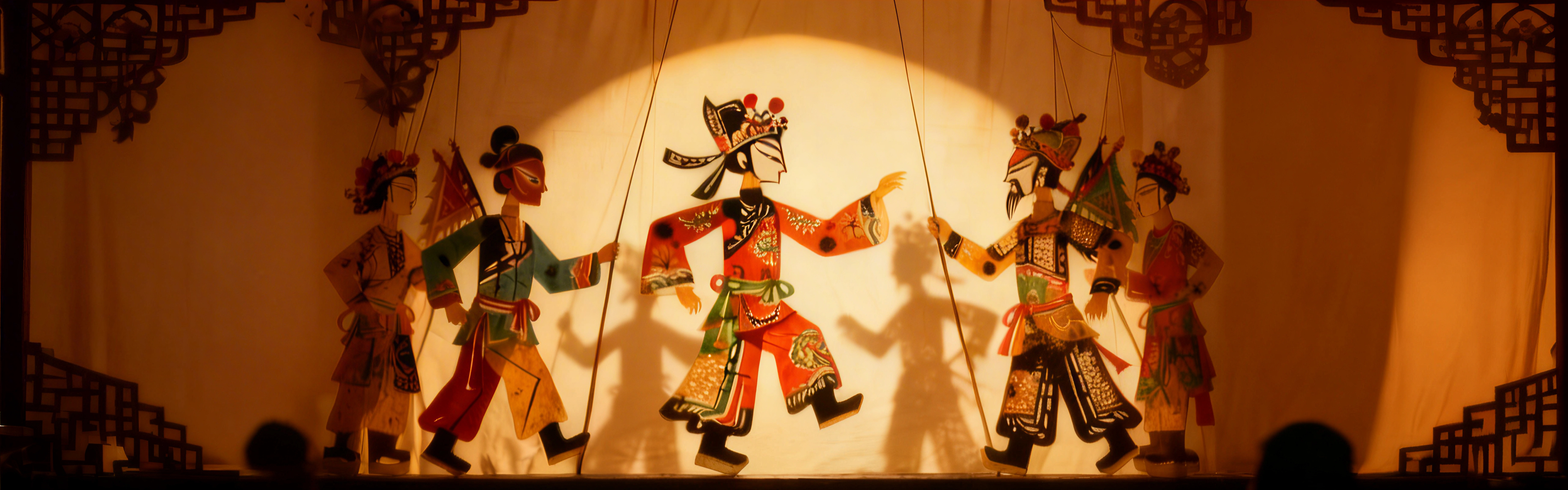
Chinese shadow puppetry is a form of theatrical performance in which intricately crafted, semi-transparent leather figures are manipulated behind a lit screen, casting vivid colored shadows for an audience. Unlike Western shadow play, which typically produces black silhouettes, Chinese shadow puppets are dyed in brilliant reds, greens, golds, and blues — making the performance a luminous, living painting.
The puppets are not simple cutouts. A single figure can have up to 24 movable joints, controlled by a puppeteer who simultaneously manipulates the figure with rods, sings the narrative, and performs the accompanying music. It is, in every sense, a one-person theater.
A 2,000-Year History: From Imperial Courts to Village Squares
The Han Dynasty: A Legend of Grief and Light
The most famous origin story traces shadow puppetry to Emperor Wu of the Han Dynasty (156–87 BCE). When his beloved consort Lady Li died, the emperor fell into inconsolable grief. An alchemist named Shao Weng claimed he could summon her spirit — he lit candles, set up a screen, and cast the silhouette of a figure resembling Lady Li. The emperor, watching from behind a curtain, wept as the shadow moved and then slowly faded.
Whether history or legend, this story captures something essential about shadow puppetry: it is an art born from the human desire to make the invisible visible, to give form to what is lost.
The Tang Dynasty: Buddhism and the People's Stage
Shadow puppetry flourished during the Tang Dynasty (618–907 CE), when Emperor Xuanzong actively promoted the arts throughout the empire. Buddhist monks adopted the form to communicate complex teachings to ordinary people who could not read scripture — the moving shadows became parables, the screen became a window into the dharma.
By this period, shadow puppetry had evolved from a court curiosity into a genuine folk art. Performers traveled from village to village, carrying their entire theater on their backs: the screen, the oil lamp, the puppets, and the scripts.
The Song Dynasty: The Golden Age
Historians and puppeteers alike agree that shadow puppetry "reached its zenith during the Song period" (960–1279 CE). In the bustling entertainment districts of Kaifeng and Hangzhou, shadow theater competed with opera, acrobatics, and storytelling for audiences. It was performed at weddings, funerals, harvest festivals, and imperial banquets alike.
When the Jin forces conquered Kaifeng in 1127, they took shadow puppeteers back north as war trophies — a testament to how highly the art was valued. The Southern Song court elevated it to palace entertainment, while rural troupes continued performing in streets and alleys, exchanging performances for food and shelter.
Through the Centuries: Adaptation and Survival
Shadow puppetry continued through the Ming and Qing dynasties, absorbing regional styles and stories. Different provinces developed distinct traditions: Shaanxi puppets are large and boldly carved; Hebei figures are delicate and intricate; Sichuan puppets are painted in the vivid colors of local opera. Each regional school reflects the landscape, music, and mythology of its home.
The 20th century brought enormous disruption. The Cultural Revolution (1966–1976) suppressed traditional arts as "feudal remnants." Many master puppeteers were persecuted, their puppets destroyed. Yet the art survived — hidden in attics, passed between family members, kept alive by those who understood what would be lost.
The Craft: How a Shadow Puppet Is Made
The creation of a shadow puppet is itself an act of devotion. The traditional process takes 30 to 40 days from raw material to finished figure.
Step 1: Preparing the Leather
The finest puppets are made from donkey hide (驴皮), though cowhide, sheepskin, and goatskin are also used. The hide is soaked in water, scraped clean of hair and fat, stretched on a frame, and dried until it becomes translucent — almost like parchment. This transparency is essential: it allows light to pass through the dyed surface, creating the glowing colors that define Chinese shadow puppetry.
Step 2: Tracing and Cutting
The puppeteer-craftsman traces the figure onto the prepared leather using traditional patterns passed down through generations. The outline is then cut with extraordinary precision using a sharp knife. A single puppet may require 3,000 or more individual cuts to achieve the intricate lattice patterns that fill the body, robes, and headdress.
Step 3: Carving the Details
This is the most demanding stage. Using a push-knife technique on slightly moistened leather, the craftsman carves the decorative patterns — cloud scrolls, dragon scales, floral motifs, geometric designs — that give each figure its character. The carving must be deep enough to allow light through, yet leave the leather structurally intact.
Step 4: Dyeing
The carved leather is painted with mineral and vegetable dyes in the traditional five colors: red, yellow, green, black, and white. These colors carry symbolic meaning in Chinese culture: red for vitality and good fortune, black for solemnity and power, white for purity or mourning. The dyes are sealed with tung oil, giving the puppet its characteristic luminous quality.
Step 5: Assembly
The finished pieces — head, torso, arms, legs, hands — are joined with thread at the joints, creating the puppet's range of movement. Three thin rods are attached: one to the neck (controlling the head and body), and one to each hand. The puppeteer holds all three rods simultaneously, bringing the figure to life.
The Performance: Voice, Carving, and Heart
A traditional shadow puppetry performance is a remarkable feat of skill. A single master puppeteer may simultaneously manipulate two or more puppets with both hands, sing all the characters' parts in different vocal registers, perform the percussion accompaniment with their feet, and narrate the story between scenes.
Lin Shimin, a contemporary shadow puppeteer from Liaoning Province, describes the art as requiring "voice, carving, and heart together." The technical skill takes years to develop; the heart — the understanding of story, character, and emotion — takes a lifetime.
The repertoire draws from China's great narrative traditions: the mythological battles of Investiture of the Gods (封神演义), the romantic tragedy of The Legend of the White Snake (白蛇传), the philosophical journey of Journey to the West (西游记). These are not merely entertainment — they are the living mythology of a civilization.
Shadow Puppetry and Journey to the West
Of all the stories performed through shadow puppetry, none has captured the imagination more completely than Journey to the West (西游记). Written in the 16th century by Wu Cheng'en, this epic follows the monk Xuanzang and his three disciples — Sun Wukong the Monkey King, Zhu Bajie the Pig Demon, and Sha Wujing the River Monk — on an 81-trial pilgrimage from China to India to retrieve Buddhist scriptures.
Shadow puppetry was one of the primary ways ordinary Chinese people encountered these characters for centuries before film or television existed. The Monkey King's acrobatic battles, the Pig Demon's comic blundering, the monk's serene faith — all were rendered in leather and light, cast onto a screen in a village square.
Sun Wukong (孙悟空) is perhaps the most beloved character in Chinese mythology. Born from stone, gifted with 72 transformations, capable of defeating armies with a single hair — yet ultimately humbled by the Buddha and redeemed through service. His red face, golden circlet, and staff are instantly recognizable in shadow puppet form across every regional tradition.
Zhu Bajie (猪八戒) is the art form's great comic figure: a former heavenly marshal reincarnated as a pig demon, perpetually hungry, perpetually complaining, perpetually suggesting the group turn back. Yet he fights when it matters, and his earthy humanity is why audiences have always loved him.
Sha Wujing (沙悟净) carries the luggage and rarely complains. In shadow puppetry, his quiet loyalty is rendered in the stillness of his figure — a counterpoint to the Monkey King's constant motion.
UNESCO Recognition: Intangible Cultural Heritage
In 2011, Chinese shadow puppetry was inscribed on the UNESCO Representative List of the Intangible Cultural Heritage of Humanity. The inscription recognized not only the art form's historical depth, but its living practice — the communities of craftspeople and performers who continue to make and perform shadow puppets today.
UNESCO's recognition brought international attention, but the challenges remain real. The number of master craftspeople who can make puppets by traditional methods is declining. The training period is long, the income uncertain, and the audience for traditional performance has shrunk as entertainment has moved to screens.
Yet the art persists — and in some ways, it is finding new audiences.
The Modern Revival: Ancient Art, New Stages
The 21st century has brought unexpected renewal to Chinese shadow puppetry. Several forces are driving this revival.
Digital platforms have given shadow puppetry global reach. Short videos of puppet-making and performance have attracted millions of views on platforms like Douyin and YouTube, introducing the art to audiences who have never seen a live performance.
Contemporary artists are experimenting with the form. In New York, Chinese-American theater makers have reimagined shadow puppetry using digital projections and live silhouettes, drawing on Chinese myths while speaking to contemporary experiences. In Beijing, young designers are incorporating shadow puppet aesthetics into fashion, graphic design, and product design.
Cultural confidence among younger Chinese generations has created new appreciation for traditional arts. Where previous generations may have seen shadow puppetry as old-fashioned, many young people now see it as a source of identity and pride — a distinctly Chinese visual language with no equivalent in Western culture.
Tourism and education have created new contexts for performance. Shadow puppetry workshops, museum exhibitions, and cultural tourism experiences bring the art to new audiences in China and abroad.
Shadow Puppetry as a Design Language
What makes shadow puppetry so compelling as a visual language — beyond its theatrical context — is its economy of means. A few lines of carved leather, a source of light, and a screen: from these minimal elements, an entire world emerges. Mountains, dragons, armies, love stories, cosmic battles — all rendered in shadow and light.
This economy is deeply connected to Chinese aesthetic philosophy. In ink painting, the unpainted space is as important as the painted mark. In shadow puppetry, the darkness surrounding the figure gives it meaning. The puppet exists in relationship to the void.
This is why shadow puppetry imagery translates so powerfully to contemporary design. The bold outlines, the intricate internal patterns, the symbolic color palette, the instantly recognizable characters — these are visual elements that carry 2,000 years of cultural memory. When you see a shadow puppet Monkey King, you are seeing not just a figure, but a civilization's way of understanding heroism, transformation, and the long road toward wisdom.
Carrying the Tradition Forward
Chinese shadow puppetry is not a museum piece. It is a living tradition, practiced today by communities across China — in Shaanxi, Hebei, Sichuan, Gansu, Liaoning, and beyond. Each regional school maintains its own distinct style, its own repertoire, its own way of making and performing.
The challenge of our time is not to preserve shadow puppetry in amber, but to allow it to continue evolving — as it has always evolved, absorbing new stories and new techniques while maintaining the essential qualities that make it irreplaceable: the intimacy of the screen, the skill of the craftsperson's knife, the puppeteer's voice rising and falling in the dark.
At COOCOZY, we believe that the visual language of shadow puppetry belongs not just in performance spaces, but in everyday life. Each of our designs carries a fragment of this tradition — the Monkey King's golden staff, the Pig Demon's nine-toothed rake, the River Monk's quiet strength — rendered in the aesthetic vocabulary of an art form that has illuminated Chinese culture for two thousand years.
To carry one of these images is to carry a story. And every story, in the end, is about the same thing: the long journey, the trials along the way, and the wisdom earned at the end of the road.
Explore our Journey to the West Collection — four characters, four stories, one ancient road.
Your cart is empty
Add pieces to begin